Handling & safety. As with other African mahoganies, dust can sensitise skin and airways for some people. Extraction and a dust mask when machining.
Suitable uses
Interior joinery, frames, furniture, doors, panelling, boat fit-out, general hardwood carpentry.
Properties
| Latin name | Entandrophragma utile |
|---|---|
| Species type | Hardwood |
| Origin | West and Central Africa — the mahogany-family timber often specified where sapele is too lively. |
| Density | 635 kg/m³ |
| Janka hardness | 5,260 N |
| Modulus of rupture | 103.8 MPa |
| Elastic modulus | 11.65 GPa |
| Crushing strength | 57.1 MPa |
| Specific gravity | 0.63 |
| Porosity | Diffuse-porous |
| Movement class | Medium |
| Tangential movement | 6.9% per 1% MC |
| Radial movement | 4.9% per 1% MC |
| Volumetric shrinkage | 11.8% |
| T/R ratio | 1.4 |
| Durability (EN 350) | Class 2 |
| Relative cost | Mid |
Typical values at around 12% moisture content. Individual boards vary.
Utile is the hardwood most people have worked with without ever asking what it was. It arrives described as mahogany, gets sold as a mahogany substitute, and sits in the same rack as sapele. It’s a genuinely good timber that deserves to be asked for by name.
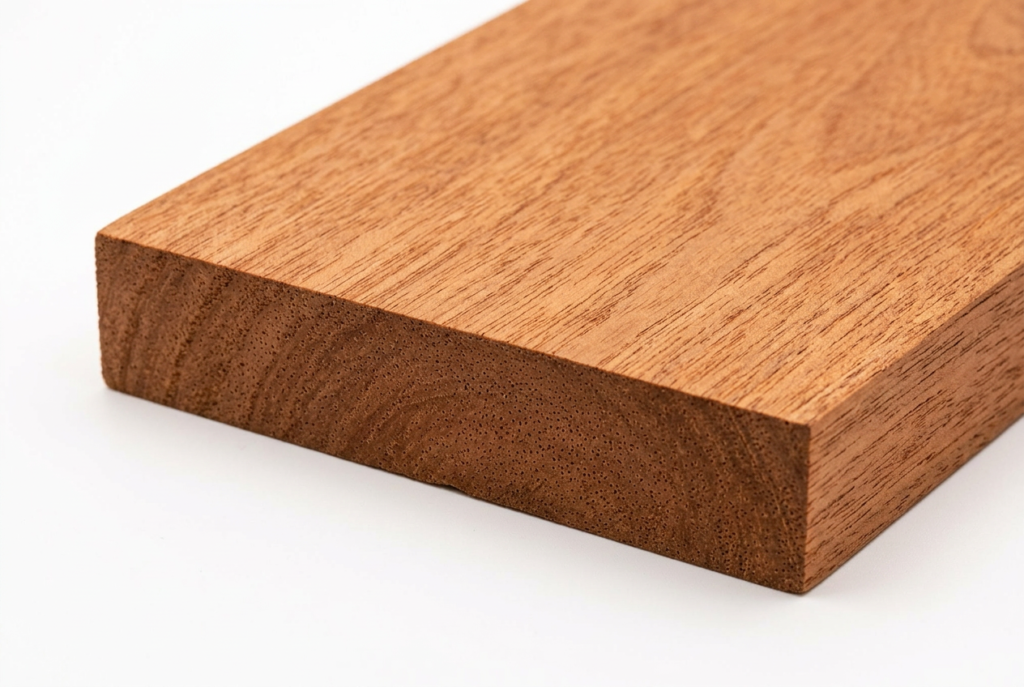
It’s a warm, mid-toned reddish-brown hardwood — generally lighter and a little plainer than sapele, with a fine even texture and good working properties. If sapele is the striped one, utile is the quieter one.
Consistency is the point
Utile’s appeal is partly that it behaves predictably. Less figure than sapele, but easier to get an even colour across a run of boards.
That matters more than it sounds. Building a piece with several matching components is easier in a plainer timber that runs evenly than in a strongly figured one that varies board to board. If you’re matching a run — doors, drawers, a set of frames — utile is often the simpler choice.
On durability, be careful with the claim
Utile is generally regarded as more weather-tolerant than sapele. It has some natural resistance, and it’s often listed as suitable for exterior work in the same breath as mahogany.
Treat that with care. “More durable than sapele” and “suitable for exposed exterior use” are not the same statement.
If a job genuinely has to survive weather, specify a species with real exterior credentials — western red cedar or thermowood both do that job properly. Utile belongs indoors, or in sheltered positions where it can dry out between wettings.
Interlocked grain, same as sapele
Utile typically has interlocked grain, so tearout is a genuine risk when planing or machining.
The answer is the same as for sapele: sharp tooling, light cuts, and attention to which way the grain runs in each section. Don’t assume a board runs one direction throughout, because it usually doesn’t.
Which one am I actually being offered?
Sapele and utile get confused constantly, and they perform differently.
- Sapele — usually denser and darker, with more obvious stripe.
- Utile — lighter, softer, plainer, more consistent across a run.
Neither is better. But they’re not interchangeable if you’re matching to work that already exists, and they don’t carry the same price. If you’re offered “mahogany”, it’s worth asking specifically which species it is.
If you’re matching to existing work and want the darker, more strongly figured option, that’s sapele — utile is the plainer, more even one.
Working the timber
Slightly softer and notably calmer-grained than sapele, so it planes with less tearout and behaves more like classic mahogany. Machines, turns and carves cleanly, which is why joinery shops like it for profiled work.
Finishing & gluing
Takes an even, warm finish with oil, lacquer or paint — its straighter grain gives a more uniform look than sapele’s ribbon. A good choice when consistency across a run matters.
Glues dependably with standard adhesives on freshly machined surfaces.