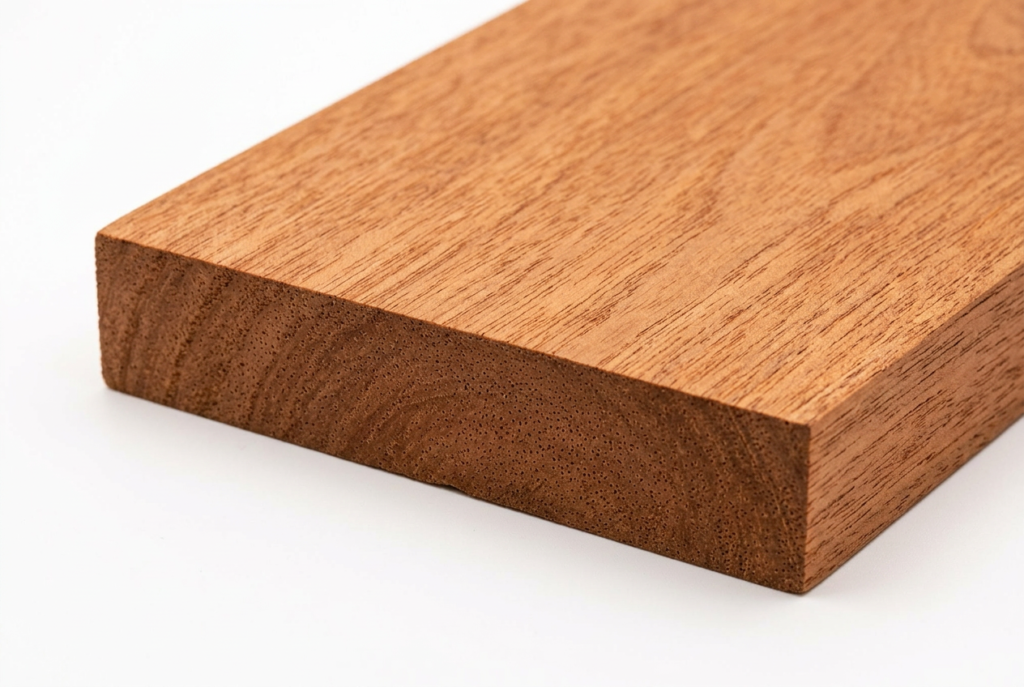
Suitable uses
Interior furniture and cabinetry, internal doors and trim, flooring, veneer and panelling. Not for exterior use or anywhere damp.
Properties
| Latin name | Quercus rubra |
|---|---|
| Species type | Hardwood |
| Origin | Eastern North America. |
| Density | 700 kg/m³ |
| Janka hardness | 5,430 N |
| Specific gravity | 0.7 |
| Porosity | Ring-porous |
| Movement class | Very low |
| Durability (EN 350) | Class 5 |
| Relative cost | Budget |
Typical values at around 12% moisture content. Individual boards vary.
American Red Oak — oak, but not the oak you’re picturing
American red oak is the most abundant hardwood in the United States and one of the most-used hardwoods in the world. It’s cheap, it’s available, it machines well, and for interior work it does a perfectly good job. It’s also the timber most likely to be sold to you as “oak” without anyone mentioning that it’s a different animal from the oak you were probably thinking of — which is the whole reason this page exists.
It’s oak, and it isn’t white oak
Botanically it’s Quercus rubra, a genuine oak in the same genus as the white oaks. But the two groups differ in ways that matter:
- It’s more porous. Red oak has open, unplugged pores in its growth rings; white oak has tyloses that block them. This is why red oak takes on water — and why it discolours and stains when it’s in contact with it.
- It’s less durable. The difference isn’t marginal. White oak is used for boatbuilding, barrels and external joinery precisely because it resists decay. Red oak is rated non-durable to perishable. It is not an outdoor timber.
- It moves more. Red oak has fairly high shrinkage and mediocre dimensional stability — noticeably more than white oak, particularly in flat-sawn boards.
- It’s cheaper and far more available. That’s the trade-off, and it’s a real one: for interior work, red oak delivers most of what people want from oak at considerably less money.
What it’s like to work
Good. It produces good results with hand and machine tools, it takes a finish well, and it’s a straightforward timber to handle. Two things follow from its porosity and its movement: it stains and discolours readily with water contact — keep it dry, and don’t leave wet rags or wet glue squeeze-out on it — and its mediocre dimensional stability means acclimatise it thoroughly and allow for movement in anything wide or flat-sawn.
Where it earns its place
Interior furniture and cabinetry, where its workability and price are hard to argue with. Internal doors, trim and mouldings. Flooring, where it’s a staple. Veneer and panelling. Drawer boxes and interior joinery. Anywhere indoors that wants an oak look at a working price.
Where it costs you
It doesn’t cost much money — that’s the point of it. What it costs you is the distinction: if you use it where you needed white oak or European oak, you’ll get a job that fails early. Exposed to weather it will discolour, stain, move and rot. The classic mistake is buying it for external joinery, doors, or anything near ground or water because it was quoted as “oak” and the price looked good.
Buying note — the one that matters. Ask specifically whether it’s red oak or white oak, and get it in writing on the quote if the job depends on it. Don’t accept “American oak” as an answer: that term covers both, and the two aren’t interchangeable outdoors. If the timber is for anything exposed, damp or in a wet environment, red oak is the wrong answer. Indoors, red oak is a sensible, economical choice and there’s no reason to pay more.
Working the timber
The Wood Database rates red oak as non-durable to perishable, with poor insect resistance, and notes it does not have the decay resistance of white oak. Shrinkage and bending figures are not stored because they were not in the checked table.