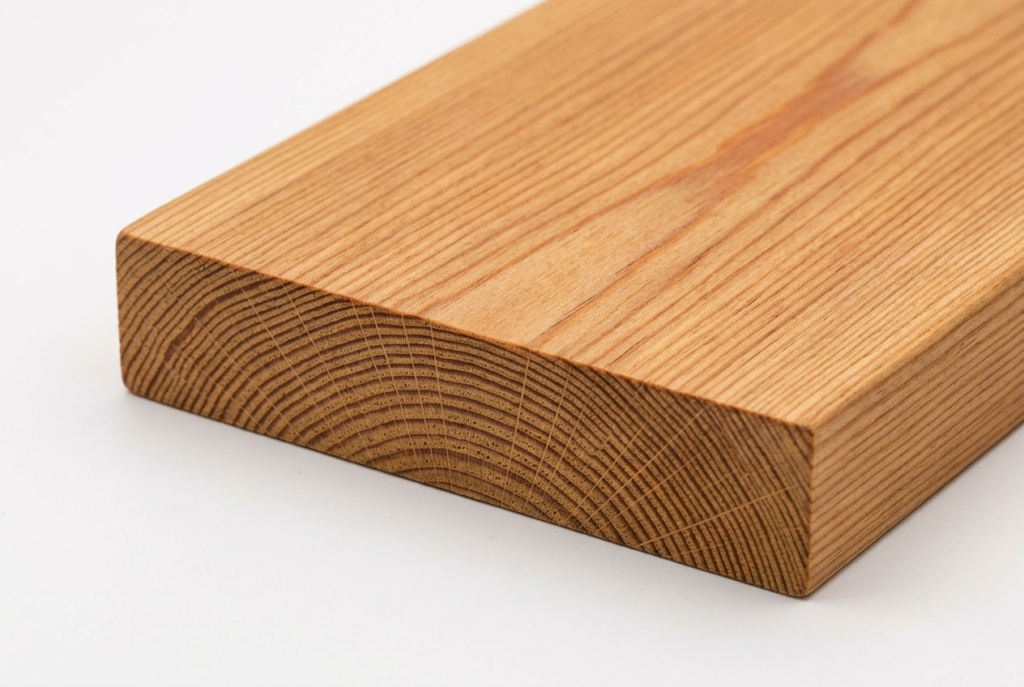
Handling & safety. Larch dust has been reported to irritate skin. Extract when machining.
Suitable uses
Cladding, feather-edge, battens, exterior joinery and structural softwood.
Properties
| Latin name | Larix decidua |
|---|---|
| Species type | Softwood |
| Origin | Central Europe, including British-grown stock. |
| Density | 575 kg/m³ |
| Janka hardness | 3,290 N |
| Modulus of rupture | 90 MPa |
| Elastic modulus | 11.8 GPa |
| Crushing strength | 52 MPa |
| Specific gravity | 0.58 |
| Porosity | Non-porous (softwood) |
| Movement class | Very low |
| Tangential movement | 8.2% per 1% MC |
| Radial movement | 4.2% per 1% MC |
| Volumetric shrinkage | 12.5% |
| T/R ratio | 2 |
| Durability (EN 350) | Class 3 |
| Relative cost | Budget |
Typical values at around 12% moisture content. Individual boards vary.
European Larch — the value exterior softwood
European larch is the traditional larch of Europe — Larix decidua — and it’s the timber people mean when they talk about larch as a value exterior softwood. It grows faster and lighter than Siberian larch, which makes it less dense and a little less durable, and it’s the species that turns up most often in fencing and general landscaping as well as in cladding.
On provenance — worth stating clearly
Larch growing in Britain is a mix: European larch in older plantings, but mostly Japanese larch and hybrid larch in modern forestry. So “British-grown larch” and “European larch” aren’t the same statement — one says where the tree grew, the other says what species it is. Both are useful things to know, and they’re separate questions. When this library says British-grown European larch, it means Larix decidua grown here — species and provenance both stated. If a quote says “English larch” with no species, it’s worth asking which larch it actually is, because the answer changes how the timber performs.
What it’s like to work
Reasonable to machine, harder to finish finely than close-grained softwoods. It’s resinous, so expect the resin to gum blades on a long run, and it can bleed through finishes — which is the main reason it disappoints in fine interior work. Predrill near ends, because larch splits.
The movement warning
Larch has a pronounced difference between its earlywood and latewood, which makes it dimensionally livelier than cedar, and its grain can be strongly spiral in some stock. That combination means it’s more prone to twisting and checking during drying, and it wants more respect in fixing than cedar does. Cladding fixed tight with no room to move will show it. Cladding fixed with proper ventilation and allowance behind it will settle down and last.
Larch weathers to a soft grey-brown over time, similar in character to cedar though usually a little darker and more variable across a run. It takes stains and oils well if you’d rather hold a colour, but the honest position is that most larch is left to weather and looks better for it.
Where it earns its place
Cladding and feather-edge where value matters more than maximum longevity. Fencing, agricultural and landscaping work, where its durability and price are exactly right. Decking and garden structures. External joinery in the right grade with the right treatment. Anywhere you need an outdoor timber that will do a decade’s work without being fussed over.
Where it costs you
It’s lighter and less durable than Siberian larch, so if you’re specifying cladding for the long haul, Siberian is the better timber and you’ll pay for it. European larch is the value option — good enough for most jobs, not the best there is. It also moves more than cedar and it’s resinous, which limits it to outdoor and utility work.
Buying note. Ask whether it’s European or Siberian, and confirm how much heartwood you’re getting on anything exposed — both questions are normal in the trade and both change the answer. If the seller says “British-grown”, ask which species, because British-grown larch is often Japanese or hybrid rather than European. For cladding, ask about grade and growth-ring tightness: it’s the main thing separating good larch cladding from indifferent.
Working the timber
Most hand and machine work goes well. The resin gums saw blades, and the soft earlywood beside hard latewood can dish when sanding. Typical figures from The Wood Database for European larch.
Finishing & gluing
It has a resinous smell when worked. Fresh surfaces take a finish once the resin is not flooding the face.
Glue freshly machined faces. Resin-rich patches can starve a joint if they are left as-sawn.