Handling & safety. Cedar dust is a known respiratory sensitiser — repeated exposure can trigger asthma-like reactions. Keep extraction going when machining and avoid sweeping dry dust into the air.
Suitable uses
Cladding, soffits, screening, garden structures, external joinery.
Properties
| Latin name | Thuja plicata |
|---|---|
| Species type | Softwood |
| Origin | North American Pacific coast; widely grown in UK plantations. |
| Density | 370 kg/m³ |
| Janka hardness | 1,560 N |
| Modulus of rupture | 51.7 MPa |
| Elastic modulus | 7.66 GPa |
| Crushing strength | 31.4 MPa |
| Specific gravity | 0.37 |
| Porosity | Non-porous (softwood) |
| Movement class | Low |
| Tangential movement | 5% per 1% MC |
| Radial movement | 2.4% per 1% MC |
| Volumetric shrinkage | 6.8% |
| T/R ratio | 2.1 |
| Durability (EN 350) | Class 2 |
| Relative cost | Mid |
Typical values at around 12% moisture content. Individual boards vary.
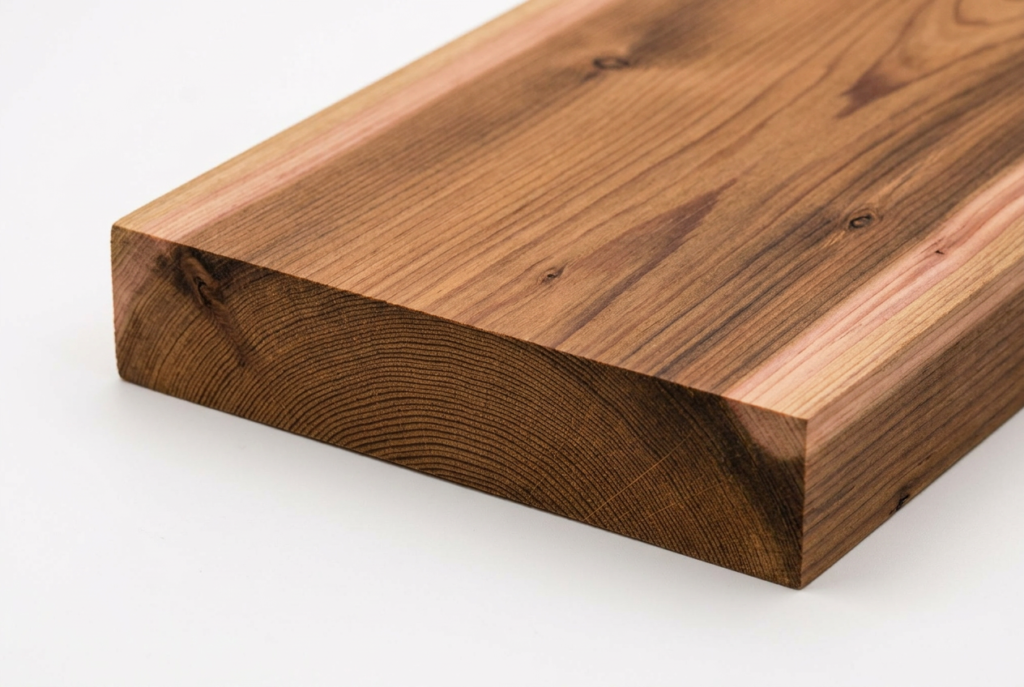
Western Red Cedar is widely used for cladding, screening and exterior joinery thanks to its natural durability and low movement. Available as boards and common cladding profiles.
Working the timber
About the easiest exterior timber to work: light, straight-grained, and gentle on edges and blades. Its low density means it dents easily, so handle finished work with that in mind. Takes screws and nails without splitting near ends.
Finishing & gluing
Left unfinished it silvers to a soft grey most people are happy to live with. If holding colour, use a penetrating exterior stain rather than film finishes — its natural extractives can slow the drying of some oil-based coatings, so check compatibility.
Glues well with standard adhesives once surfaces are freshly machined and dust-free. Very old, weathered surfaces should be planed or sanded back before bonding.